

On intrinsic dynamics
The most common questions I am asked about my rope practice tend to be related to the specific patterns or sequences of ties. While I understand this is a big part of the mystery for new riggers I really think it is the wrong focus. For whatever reason though, most likely related to the huge popular success of Shibari Study or its precursor, the 1 hour con class, it becomes the focus. Don’t get me wrong, you should know at least a couple of patterns. But, I think there is huge value in also paying attention to skills of movement. I discussed this in detail over here as well: https://boshaiart.com/2022/12/30/flight-log-december-30-2022/
But let’s talk about some interesting studies related to this. It will come as no surprise to you that this hasn’t really been researched in the context of rope specifically, but there are many human activities which require inter-limb coordination, timing, and accurate self perception as we move through space. One such example is playing music, drums to be precise. This has actually been studied extensively!
- https://www.science.org/doi/10.1126/science.424729
- https://www.nature.com/articles/s41598-022-11783-8
- https://assets.researchsquare.com/files/rs-1016139/v1/d3d18922-953d-4df5-83db-510b59e67610.pdf?c=1637359512
For most of these studies, participants were either instructed to drum with their hands or with a pair of drumsticks, in time to a metronome that got progressively faster as time went on. They were observed to see what their natural approach to this task would be and then their error rate was tracked when they were instructed to replicate more complicated rhythm patterns. When given a pair of drumsticks there is a potentially unlimited number of combinations of hand heights (or stick angles) the drumsticks can be moved through as a person attempts to make a beat. This is called the relative phase. What we find is that even though there is this huge field of possibilities the person can move through, there are some very strong local minimums. These would be a relative phase of zero, meaning the drumsticks hit at the same moment, and a relative phase of 180, meaning the drumsticks are moving in exact opposite moments – so when one drumstick is all the way up, the other is hitting the drum. This has been shown to be true for about 75% of people studied, with the remaining quarter of people also having a strong local minimum at a relative phase of 90, so when the drumstick is halfway through its path the other one starts to move as well.
We see this pattern of movement (also sometimes called an intrinsic dynamic) holds true across an incredibly wide variety of actions. Not just in drumming are you most likely to see a phase of either zero or 180 but also with walking, skiing, certain movements in dance, etc etc Interestingly, on a more finely detailed level you can see that the most common relative phase for the two halves of a person’s leg when they are walking is zero. Meaning, the part of the leg above the knee and below the knee moves at the same time as a person takes a step. However, for infants new to walking they have a very unpredictable relative phase until about month 2. As they learn to walk, they try out a variety of different phases until they land on the one which is most efficient. In this case zero.
We can also see that this has some strong implications for teaching adult learners of physical skills to change their movement patterns. Once an intrinsic dynamic is set in stone it can be very hard to change it. If you don’t believe me, try to bang out a drumroll right now on the surface in front of you. And now try it again where once one hand is up 20% of its path, the other starts to move. If you get confused by this and revert back to either zero or 180, don’t be alarmed – that’s normal!
There is also the rather interesting case of Tim Tebow, a former American football star who had a promising career in the NFL cut short by what has been credited as an inefficient intrinsic dynamic. Even though he won the Heisman trophy, the most prestigious award in college ball, and was scouted as a top prospect to join the Denver Broncos, he had a seriously lackluster performance at the pro level and washed out of the game in just 3 seasons. Upon close analysis of his game it was discovered that he carried the ball much lower than other top players, and when he went to initiate a throw, it took him .06 seconds in comparison to the NFL average for quarterbacks of only .04 seconds. This meant that he simply got tackled more often. At the college level where the defensive players were just a bit slower, that extra .02 seconds didn’t make a difference, but when he was playing the best defensive players in the world, clearly it did.
Further, it was discussed heavily at the time he washed out that his coaches tried extensively to change his form. But after so many years he had spent reinforcing this lower carrying position and longer throw, he just couldn’t change it in time to make a difference.
Now lucky for us, rope isn’t a competitive contact sport where a .02 difference in timing will win or lose us a game. However, I have noticed that once a weird movement pattern gets baked into someone it can be very hard to change it. If the movement pattern is harmless, that’s just fine, and in fact it probably adds something to have a unique way of moving as you tie, but more often it stands out that someone is jerking their partner around heavily or causing pinches and minor burns due to the way they are handling the rope.
I had a student a couple of months ago who knew a ton about rope, and was very proficient at moving through a suspension or tying specific complicated patterns. However, when we worked on a basic exercise where I asked him to tie his partner’s wrists and then draw a single rope around her upper body as smoothly as possible, he really struggled to do this. What I noticed was that as he transferred the rope from one hand to the other he threw his whole arm around his partner to catch the rope on the other side of her body, rather than moving the rope to the waiting hand. We worked on changing this movement pattern, but when the tie got more complicated and he got distracted, that old intrinsic dynamic kept reappearing.
I didn’t have a good answer for how to prevent this then, but after researching it more there seems to be something to this relative phase that is actually very relevant to rope. When people are presented with a complex series of tasks that involve coordination between limbs they can become overwhelmed by the options and not find their way to an efficient relative phase. We can see that zero and 180 are the most common solutions for these types of tasks but they are far from the only solutions, otherwise nobody would be able to play complicated music!
That said, based on the research I have done there is an argument for limiting the degrees of complexity at the start, in order to establish good habits as it relates to the movement pattern, before adding other layers of complexity. It is also important to start with tasks which are easily achieved. Another example from sporting we can see is that for youth basketball leagues they lower the height of the basket. Most young players lack the height and physical strength to effectively toss the ball into a full height net, and therefore if they play only on a regulation court they develop poor form which they have to unlearn later. If they instead play on a lowered net where they don’t have to throw their whole body into the ball in order to get it high enough to go in, they develop much better movement patterns.
In a rope context this is an argument in favor of more minimalistic scenes, and as the common wisdom says, staying on the floor for as long as it takes the rigger to develop efficient movement patterns. It also leads to a question of what efficiency really means in a rope context. For me, it is all about making the sensation of applying the rope as smooth and seamless as possible for your bottom. Even when I make a big movement as I apply the rope, or really push into my bottom and try to raise the intensity, I try to do it with smoothness. Jerking the body, pulling rope too quickly, or causing pinches as we finger hook, all represent not only inefficiencies in the tying technique but negatively impact the bottom’s enjoyment of the tie in my experience.
And anyways, the head game is much more interesting to me than the rope. As on a recent tie with FavoriteBlanket, who requested to play with exposure.


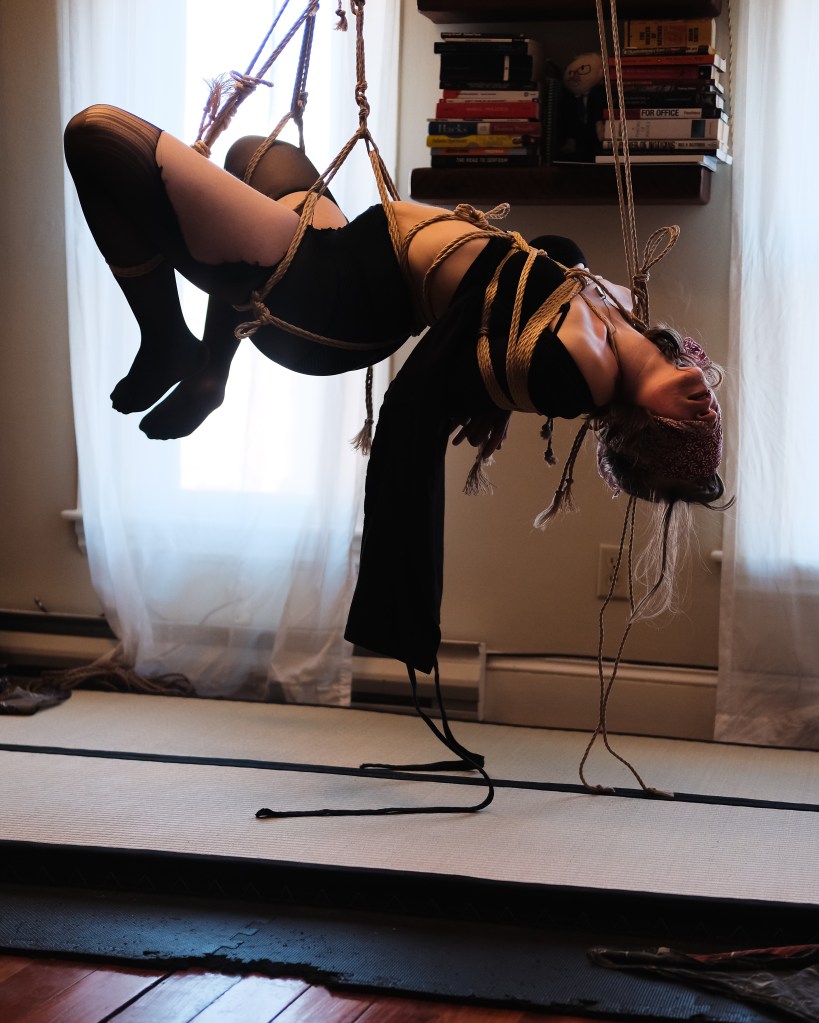
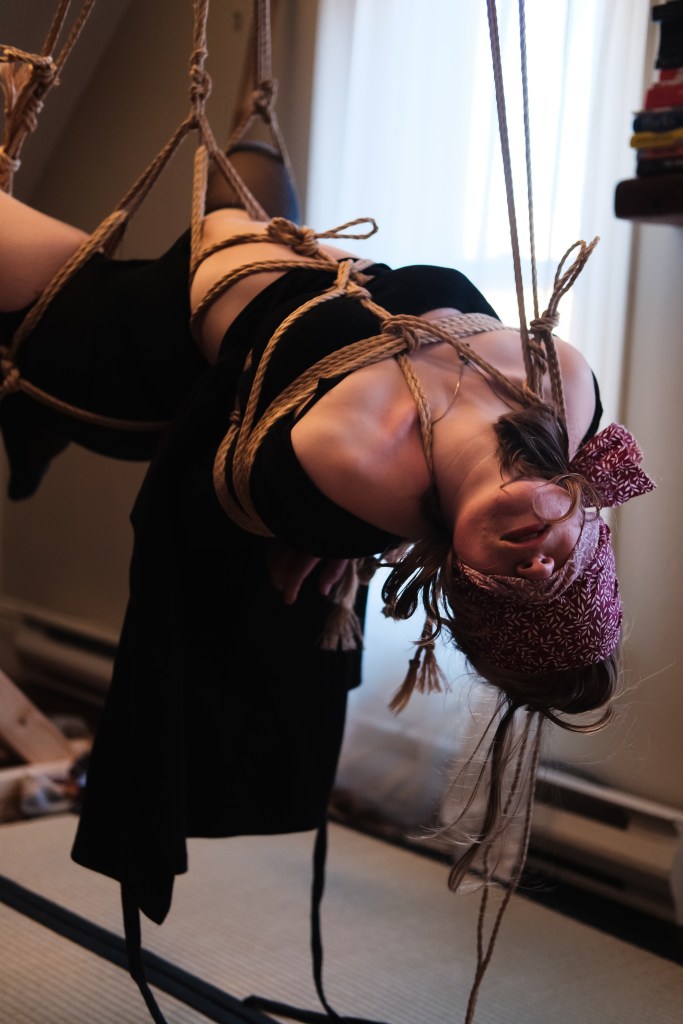


As we moved through the tie, for me it became an exercise in smoothness and restraint. I tried to focus on moving slowly and deliberately through every transition, and really taking my time to press the rope into place as I added the very simple single column ties and minimalist hip harness. I also chose not to remove the clothing fully, as I think there is something much more shameful about being half dressed – as though you have also been caught in a transition moment. Neither fully presentable nor fully naked.
Big thanks to FavoriteBlanket for her excellent bottoming as always, and for coming with an idea to explore 🙂
 boshai
Loved reading through this one. It really opened my eyes to movement and smooth rope that first time we shared space and I’m deeply grateful for that subtle learning moment.
LikeLiked by 1 person