

On Walden Pond and boundaries
The primary tourist attraction available to you, humble traveler, in the town my parents live in is rocks. As you point your nose east out of Boston and peddle out to the sticks, what you can’t get is a decent cup of coffee, but you are sure to find a heaping pile of earth. Many such piles. At least 14,000 years ago a giant ice sheet scraped its way clean through to Cape Cod, leaving behind randomly occurring boulders – stood out in the middle of fields, or wedged into hillsides, or even in good ol’ Plymouth of the pilgrim fame. These Glacial Erratics came in all manner of sizes and proved to be a boon to the local population of masons, who criss-crossed this land with expertly stacked stone walls, many of which still mark the boundary lines of their descendants’ properties. The commonwealth is nothing if not well exfoliated.
And this legacy of fences extended to another glacial gift, Walden pond, of Thoreau fame. The enemy of high school lit students everywhere, Mr. Henry David built himself a house on the shore of Walden pond and called himself a recluse. Perhaps it was more remote in his day, but the size and proximity to downtown Concord makes me think that bathing in these hallowed waters would be about as spiritual and impressive as splashing in a puddle in a Walmart parking lot. But we all need our fantasies of ruggedness – this is after all what America was built on.
Keen students of the history of New England will know that there are hardly any old growth forests left to us here. As it happens the white man clear cut almost straight through to Georgia, and try as we might to plant back the trees, on the shores of Walden pond there is an eerie artificialness to it. The trees are too young, too far apart. Undergrowth is kept at bay by trampling feet, not the sun dampening foliage of elder trees. It has the feeling of a forest-garden which was dreamed up in the 70s, because well, that’s what it is. And more ironically, in this Church of Nature, the entire pond-circling walking path is fenced in on both sides with an narrow, wire picket.
Now, if you have anything approaching my inseam, you can step over the wires. But the psychological effect is the same- “Civilization is on this side, and nature is on that side.” You are not invited to step outside the wire, but merely to look from a distance. But it’s hard not to linger on the sheer arbitrariness of it all. Nature, is not an empirical category but an imagined one – imagined in the mind of Mr. Thoreau just as it was in my own mind, tramping through the Montana woods only to be disappointed by the appearance of a fire road deep out in the bush. The humans are here, and we are part of it. All you have to do is duck under the fence.
The irony does not escape me that in spite of how unimpressive I found Walden (and its gift shop), it did inspire this writing. Mostly because it reminded me of an early pedagogical lesson I received on kinbaku. The gist of which was that you must use rope and only rope, and in order to make it about dominance and submission, as was the order of the day, you should start either with the wrists or the neck. Now, this is not entirely ridiculous. For the excited, new rope top, establishing some limiting criteria is a necessary and prudent step. And so, dutifully, I began every scene for years with either a binding of the wrists or a column tie around the neck. Hot.
Eventually, however, I started to open myself to the idea that this arbitrary distinction was just that, arbitrary. And with the help of my most bad-ass of rope bottoms, Suidae, we started to push beyond this fence as well. I still believe in the utility of containing the arms – and maybe this seems obvious to you, but it was a huge mental challenge to simply not tie the wrists. If you look through my pictures you will start to notice that in almost every image, the person’s wrists are tied. This is after all, the first step in tying a gote.
It happened the first time entirely on accident – I had just returned from Belgium where I was immersing myself in the style of Nicolas Yoroi, and practicing some one rope play. Suidae and I dancing in the way that only they can dance, when I realized I had established what were actually quite usable upper wraps on an arms front harness, lack of wrist-cuff be damned! I continued to tie the rest of the harness, freestyling as I like to do, and locked it off – checking to make sure we were not ripping Suidae’s thumbs off. I learned many lessons from that tie – one being that the thumbs can actually be used very successfully as an anchor point, and also that thumbs are not wrists.

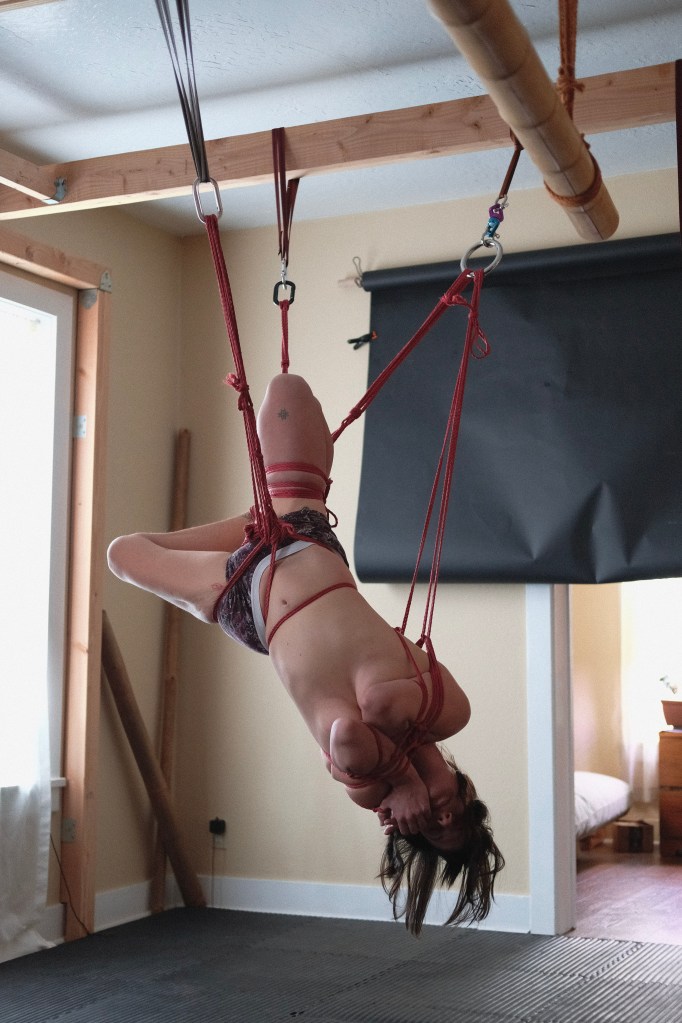
If you, seeing this, would like to try the same – there are some details which are important to consider.
One, that you must find a way to break the tension in the line from the thumbs to the rest of the harness.
Two, that your bottom has the ability and body-knowledge to sense when they are having nerve problems without the ability to do the thumbs up test or raise their wrists.
And three, that you do not tie yourself into a corner without the ability to untie the fingers quickly.
There are several other details, which frankly go beyond the scope of this writing, but I am happy to answer questions via email and/or show this concept in more detail in person!
But the story continues – as we got more practiced and confident as a team at tying the fingers, I wanted to push the boundaries of my rope even more. I decided to try using different materials, while attempting to keep the aesthetics of rope bondage. Unlike the standard kinky bondage, with its focus on pink handcuffs and leather strapping, I wanted to keep to shapes which would be possible to create with rope. Mostly, because I find them beautiful, whereas my primary dislike of the full gimp approach is it tends to turn the person into a bit of a sausage. Using pipecleaners, I bound Suidae’s fingers and eventually toes – and then used bungee cords to bring them into a seated position with the potential for a bit of rocking movement.
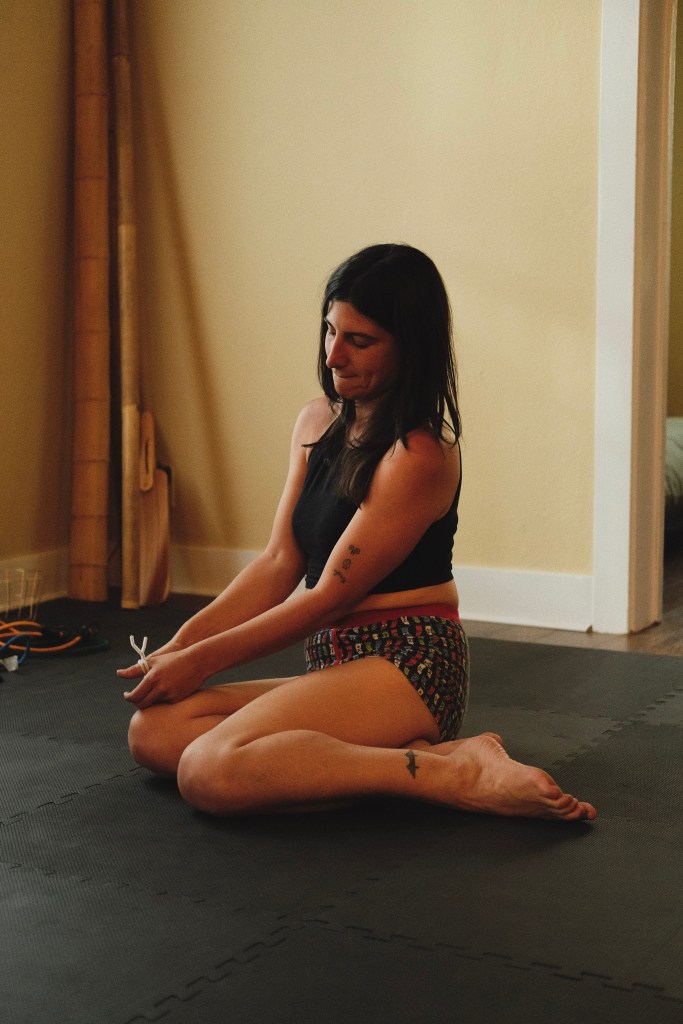
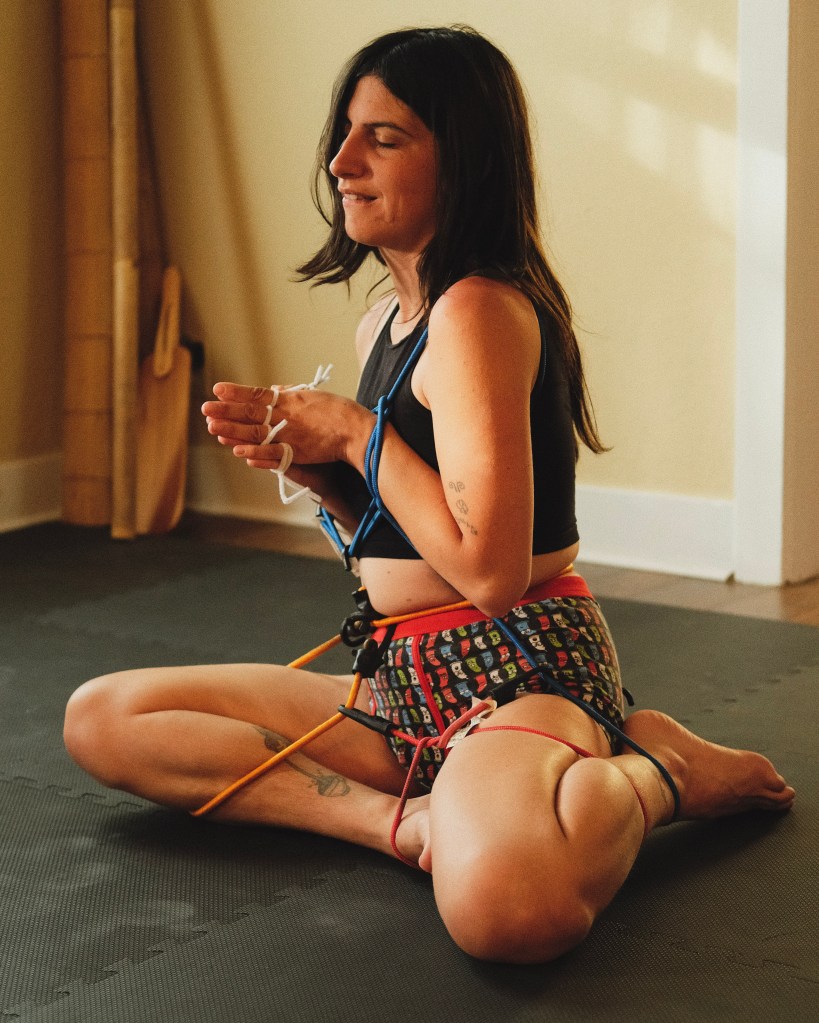
From here I wanted to play with the limited motion and lean in to the stretch of the bungee. Unlike jute which has very little stretch and becomes rigid under tension, bungee lets the position breathe. However, it is also a much less predictable material – as the tension changes with every breath and shift of weight. You can’t set it like you can with standard rope.
I added another material, webbing, to bring them into an off balanced partial.
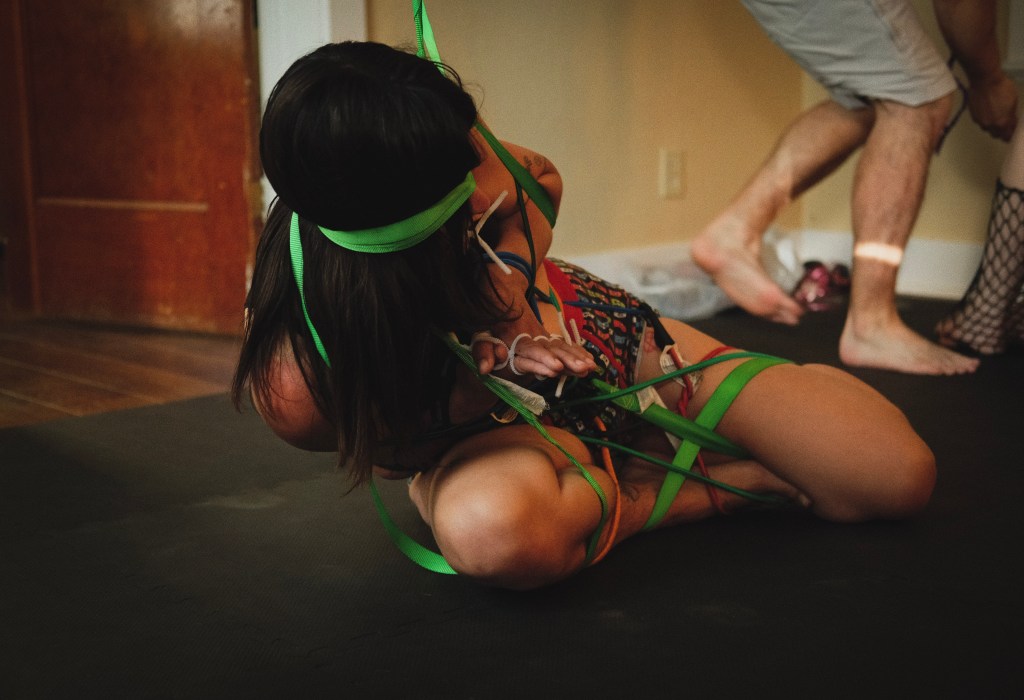
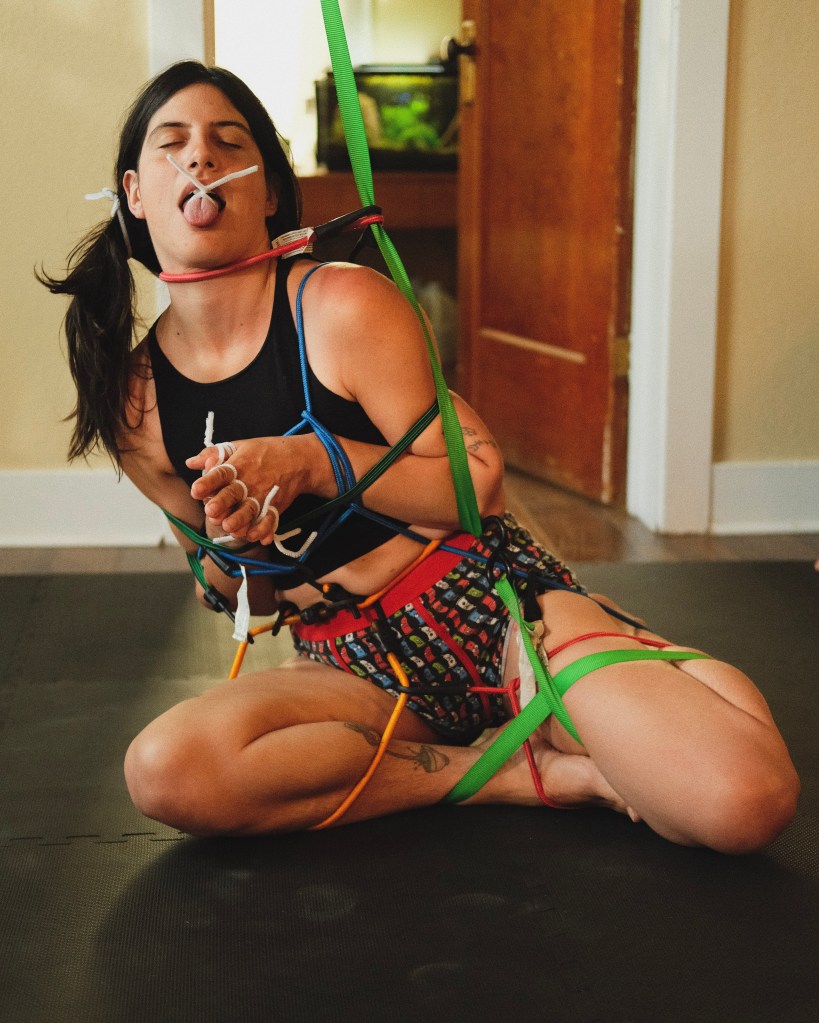
From here we played for a while, adding elements and then removing them – only to add more.
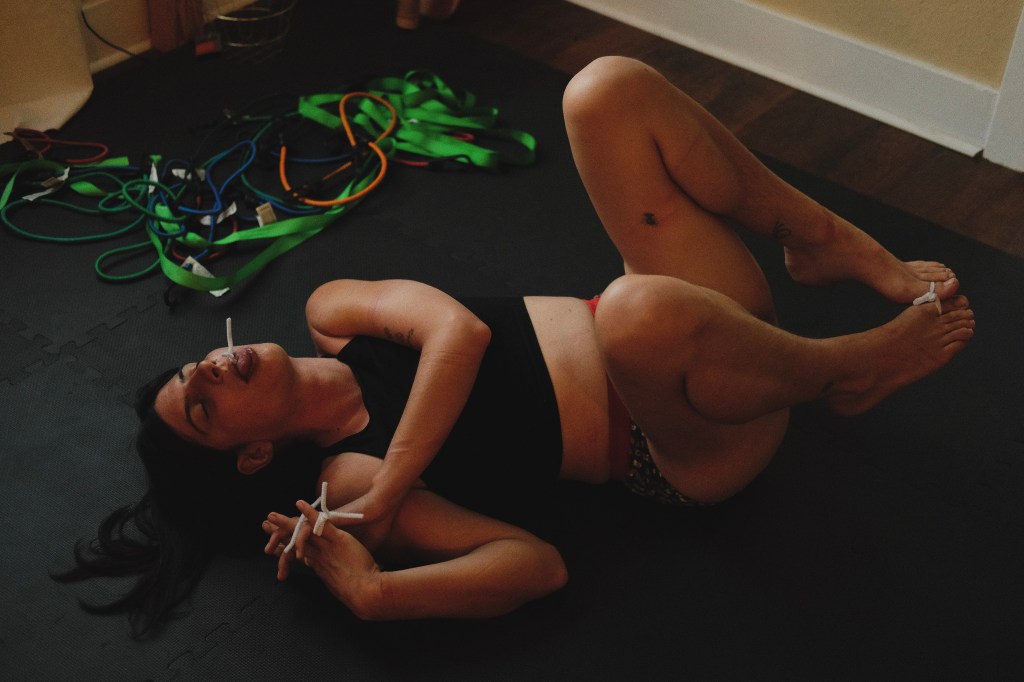
If I have any parting wisdom to offer on this writing it is that I have come to understand rope as something without hard boundaries. You can get very deep in the meta about it, and explore the mental bondage of D/s, or you can explore just at the edges of your current repertoire – moving a few inches south of the wrist to the fingers. But like a video-game map that starts entirely covered up in fog, all it takes is a bit of exploration to find something new and worthwhile.
It goes without saying that none of this would be possible without the true collaboration and insights brought by Suidae. Miss you!
 boshai