

There are many ways to find inspiration in rope. I think most of us default to the visual, seeing images of ties others have done. Sometimes we reference the established “masters” of the practice, or just copy what our peers are doing in our neighborhood. Overall I think this is positive – its accessible, fairly straight forward, and gives both halves of the scene the same reference to work off of. The bottom doesn’t have to guess what the top is trying to do, they can see the desired end result before the tie even starts. Maybe you can already guess that this last point is also a potential criticism, and that having this desired image to recreate can really limit you.
I’m always interested in interdisciplinary approaches, finding ways to relate knowledge gained in one area back to rope and vice versa. When I first made an attempt to get better at street photography (it’s still dismal to be honest) the advice that struck out to me is that its all about making opportunities and then noticing when they have been taken. In the case of the street photographer, maybe this means you notice when certain architectural features make a natural frame, or where the light is dramatic, and then you can post up and wait for someone to walk through. At other times you can explore an area in search of vignettes to capture. Both approaches lead to a very different appreciation for the built environment in my experience. When you go out searching for beauty you are more likely to notice it.
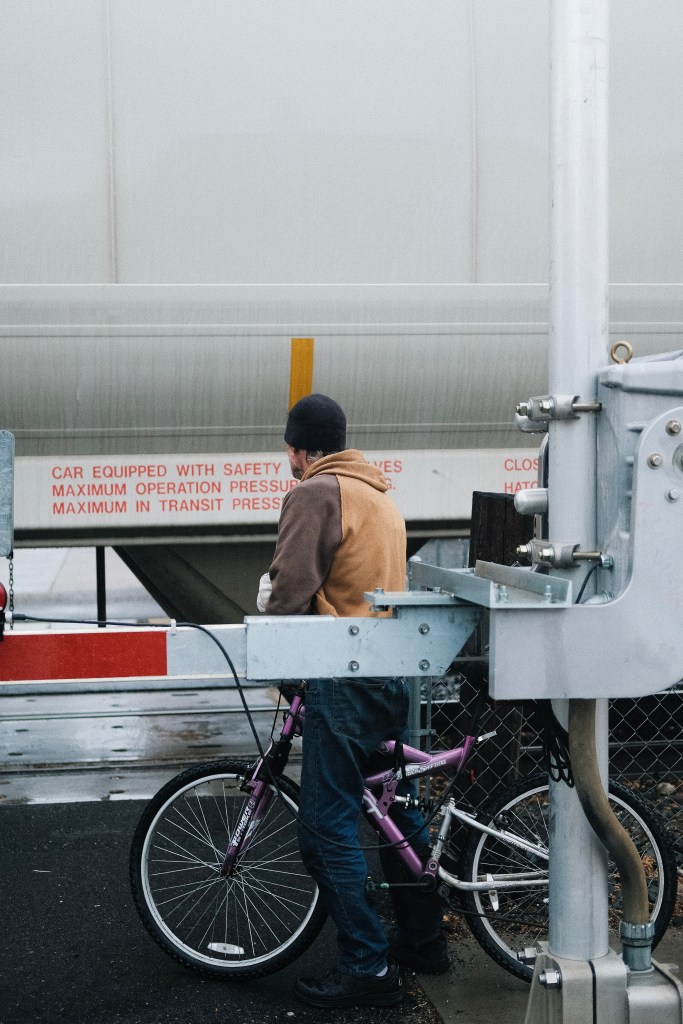
As an example, I attended a music festival in Billings MT a few months ago that had venues on either side of these train tracks. Over the two days we crossed them perhaps a dozen times, and I was drawn to the way the locals got right up close to the huge freight cars. It was very imposing, and seemed like a good opportunity for an image. So I waited until the right character made his way into the frame.
These recent days as I have been walking around Boston, I am again trying to notice opportunities. In this case there is a stream running across the path I take to the gym. At first it was just a pretty feature, but the more often I crossed it the more curious I became about its story, and if I could write one about it myself. It sounds a bit pretentious and goofy, but I really think it is the key to building an engaged life. Moreover, it is a way to practice the mindset of noticing. Ok, a quick break for poems and then we can get to the rope.
And we're in the middle of a conversation about

How the street names of Dublin
play telephone to the imagined past,
translated and changed from the Gaelic
to English and ‘back’ as something new.
And how the Alewife Brooke is no such river, but a road -
where you can walk and be forgiven
for not knowing that an Alewife is a fish.

No, a train station,
an end point.

Lives, of these forgotten creatures -
six pence for a pound, a thousand in every net-scoop,
now waiting in the metallic half-life
of an artist’s ugly tribute,
shadowed by storm drain, flattened cans in the shapes of fish.

And a headstone - crumbling in the way that paper does.
And herons, fighting, or it might be dancing.
And water, still - but running.
Is that all the river is?
A wrinkle in the land, where water falls?
Nothing but a path of least resistance?

A sad fate for an empire, but no less wrong
to put a Starbucks at the colosseum
than make a walking path where deer should drink.
Or try to know the river now as she is,
where still the gentle tipping of a duck,
ever forward to the mangled depths,
is reason enough why she remains.
That love, like that, flows in the path of least resistance,
and the Alewife lives forever -
a direction of travel
Whenever I don’t really know what to do in a tie, I try to go back to these basic principles of noticing opportunities. My lovely friend Favoriteblanket came back for a sunny afternoon tie, and we agreed on a simple enough concept – to make some unusual shapes and create a physical challenge. So we can see how this might play out in real time, when I don’t have a plan or set poses I want to hit in a transition sequence.
When this is the case, I like to start really with anything. Here I tied one side of the body into a half crab tie, to not block the mobility of the upper body as I did in our first tie together by using a TK. I then sat back and just watched how she settled into it – thinking about how I could create a more dynamic shape or move into a more twisted position as we had discussed. Pulling the free arm around the body to add some counter twist and lifting the leg seemed like an obvious choice.


When you add structure you’re simultaneously limiting your options and creating new ones. Tying the second leg into a futomomo restricts the ways you can move it, but now there are two good connections points onto which you can fix an upline. I picked the obvious choice – to open the legs by pulling from the outside of the futomomo.

This created a very beautiful shape, and we explored it making only minor adjustments for a few minutes. But just as a street photographer can pick up and move to a new location, I decided to drop the futomomo and untie it. This had a double effect of increasing the physical intensity by loading all of her weight onto the chest and crab tie, and presented the ability to move into an inversion by loading the ankle.
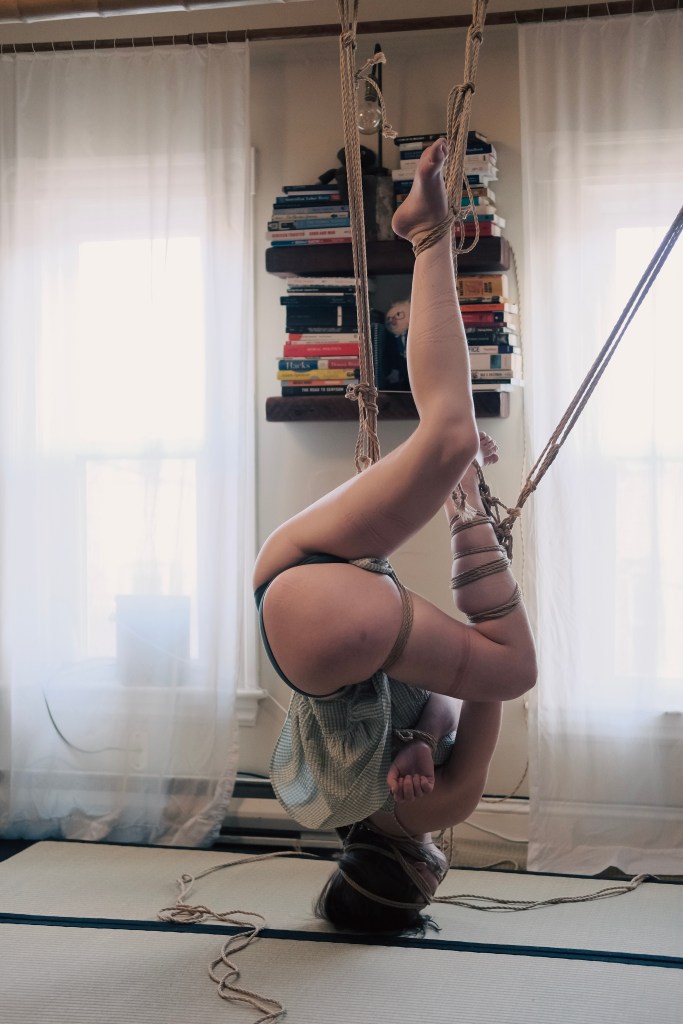
Finally, there was more twisting on the way down. I tied a hip line while she was inverted and loaded that to take some pressure off of the crab tie, and then brought the leg down to see how she would fold into the hip.


As you can see, she folded very nicely! 🙂
I think the interesting thing in this tie is that there were many places where favoriteblanket could have straightened her body out more. Especially in this last transition, she could have brought the leg to the front of her body – but she chose instead to explore the more contorted shape. Maybe this tells us something, but mostly I think it is just a nice feature to notice and appreciate. Big thanks to her!
 boshai